

| 名称 | Human IgG3 CH23 Protein |
| 纯度 | >90% as determined by SDS-PAGE&HPLC |
| 表达宿主 | 293 Cells |
| 标签 | His |
| 种属 | Human |
| 分子量 | 32 kDa |
| 缓冲液 | 50mM Tris, 300mM NaCl, 5%Sucrose, PH:8.5 |
| 稳定性 & 储存条件 |
-80 ℃ packaging and storage to avoid repeated freezing and thawing. |
| SDS-PAGE |

|
| HPLC |

|
Immunoglobulin G3 (IgG3) is a member of immunoglobulin G produced and secreted by many effective B cells. After gastric protease cleavage, IgG is divided into two F (ab) fragments, each with an antigen binding site and a highly conserved Fc fragment. The Fc segment has highly conserved N-glycosylation sites. The C region of the Igγ-3 chain (IgG3 Fc/IGHG3) contains two constant regions (CH2, CH3) of the IgG3 H chain. The CH23 domain is crucial for its function, as its glycosylation and charge characteristics affect its affinity. Mouse IgG3 has potential therapeutic applications, particularly in the development of chimeric antibodies for infectious diseases.
| 名称 | Mouse IgG3 CH23 Protein |
| 纯度 | >95% as determined by SDS-PAGE&HPLC |
| 表达宿主 | 293 Cells |
| 标签 | His |
| 种属 | Mouse |
| 分子量 | 29kDa |
| 缓冲液 | PBS, pH 7.4 |
| 稳定性 & 储存条件 |
-80 ℃ packaging and storage to avoid repeated freezing and thawing. |
| SDS-PAGE |

|
| HPLC |

|
Immunoglobulin G3 (IgG3) is a member of immunoglobulin G produced and secreted by many effective B cells. After gastric protease cleavage, IgG is divided into two F(ab) fragments, each with an antigen binding site and a highly conserved Fc fragment. The Fc segment has highly conserved N-glycosylation sites. The C region of the Igγ-3 chain (IgG3 Fc/IGHG3) contains two constant regions (CH2, CH3) of the IgG3 H chain. The CH23 domain is crucial for its function, as its glycosylation and charge characteristics affect its affinity. Mouse IgG3 has potential therapeutic applications, particularly in the development of chimeric antibodies for infectious diseases.
| 名称 | Human IgG2 CH23 Protein |
| 纯度 | >95% as determined by SDS-PAGE&HPLC |
| 表达宿主 | 293 Cells |
| 标签 | His |
| 种属 | Human |
| 分子量 | 32 kDa |
| 缓冲液 | 50mM Tris, 300mM NaCl, 5%Sucrose, PH:8.5 |
| 稳定性 & 储存条件 |
-80 ℃ packaging and storage to avoid repeated freezing and thawing. |
| SDS-PAGE |

|
| HPLC |

|
The human IgG2 CH23 protein is an important component of the human immune system, derived from the IgG2 subclass of immunoglobulins. IgG2 antibodies play a crucial role in regulation and complement activation, aiding in the neutralization of pathogens. The IgG2 Fc region, including CH2 and CH3 domains, has been studied for its structural changes during Fc conformational changes. The CH2-CH3 interface is highly conserved and plays a functional role in regulating the binding of FcγR and other proteins to Fc. This protein fragment is typically expressed in HEK293 cells and used for various biomedical applications, including research, diagnosis, and treatment. Its high specificity and affinity make it a valuable tool for studying immune responses and developing new therapies for diseases.
| 名称 | Mouse IgG2c CH23 Protein |
| 纯度 | >95% as determined by SDS-PAGE&HPLC |
| 表达宿主 | 293 Cells |
| 标签 | His |
| 种属 | Mouse |
| 分子量 | 29kDa |
| 缓冲液 | PBS, pH 7.4 |
| 稳定性 & 储存条件 |
-80 ℃ packaging and storage to avoid repeated freezing and thawing. |
| SDS-PAGE |

|
| HPLC |

|
Antibodies protect pathogens and diseased tissues from invasion through various mechanisms, including neutralization, antibody dependent cell-mediated cytotoxicity (ADCC), complement mediated cytotoxicity, phagocytosis, and phagocytosis. The mouse strain expresses three IgG2 subclasses: IgG2a, 2b, and 2c. The Fc ring residue of mouse IgG2c promotes stronger receptor binding affinity than mouse IgG2b or human IgG1.
| 名称 | Mouse IgG2b CH23 Protein |
| 纯度 | >95% as determined by SDS-PAGE&HPLC |
| 表达宿主 | 293 Cells |
| 标签 | His |
| 种属 | Mouse |
| 分子量 | 30kDa |
| 缓冲液 | PBS, pH 7.4 |
| 稳定性 & 储存条件 |
-80 ℃ packaging and storage to avoid repeated freezing and thawing. |
| SDS-PAGE |

|
| HPLC |

|
Mouse IgG2b CH23 is a subtype of immunoglobulin G (IgG) antibody produced by B cells in response to an antigen. It is the third most abundant IgG subtype in the serum and plays a crucial role in the adaptive immune response. Mouse IgG2b is composed of two heavy chains and two light chains and is involved in opsonization, complement activation, and antibody-dependent cell-mediated cytotoxicity (ADCC). It also plays a role in the regulation of immune responses, including the activation of T cells and the inhibition of B cell activation.
| 名称 | Cerebellin-1 Protein |
| 纯度 | 90% |
| 宿主细胞 | HEK293 |
| 序列 | MLGVLELLLLGAAWLAGPARGQNETEPIVLEGKCLVVCDSNPTSDPTGTALGISVRSGSAKVAFSAIRSTNHEPSEMSNRTMIIYFDQVLVNIGNNFDSERSTFIAPRKGIYSFNFHVVKVYNRQTIQVSLMLNGWPVISAFAGDQDVTREAASNGVLIQMEKGDRAYLKLERGNLMGGWKYSTFSGFLVFPL |
| 基因名 | CBLN1 |
| Uniprot ID | P23435 |
| 物种 | Homo sapiens(Human) |
| 产品性状 | Liquid |
| 缓冲液 | 1×PBS,pH7.4 |
| 储存方式 | -80 ℃ packaging and storage to avoid repeated freezing and thawing. |
| SDS-PAGE &WB |

|
The cerebellin peptide exerts neuromodulatory functions. Directly stimulates norepinephrine release via the adenylate cyclase/PKA-dependent signaling pathway; and indirectly enhances adrenocortical secretion in vivo, through a paracrine mechanism involving medullary catecholamine release (By similarity).
| 名称 | Proto-oncogene tyrosine-protein kinase Src |
| 纯度 | >90% |
| 宿主细胞 | HEK293 |
| 序列 | MGSNKSKPKDASQRRRSLEPAENVHGAGGGAFPASQTPSKPASADGHRGPSAAFAPAAAEPKLFGGFNSSDTVTSPQRAGPLAGGVTTFVALYDYESRTETDLSFKKGERLQIVNNTEGDWWLAHSLSTGQTGYIPSNYVAPSDSIQAEEWYFGKITRRESERLLLNAENPRGTFLVRESETTKGAYCLSVSDFDNAKGLNVKHYKIRKLDSGGFYITSRTQFNSLQQLVAYYSKHADGLCHRLTTVCPTSKPQTQGLAKDAWEIPRESLRLEVKLGQGCFGEVWMGTWNGTTRVAIKTLKPGTMSPEAFLQEAQVMKKLRHEKLVQLYAVVSEEPIYIVTEYMSKGSLLDFLKGETGKYLRLPQLVDMAAQIASGMAYVERMNYVHRDLRAANILVGENLVCKVADFGLARLIEDNEYTARQGAKFPIKWTAPEAALYGRFTIKSDVWSFGILLTELTTKGRVPYPGMVNREVLDQVERGYRMPCPPECPESLHDLMCQCWRKEPEERPTFEYLQAFLEDYFTSTEPQYQPGENL |
| 基因名 | SRC |
| Uniprot ID | P12931 |
| 物种 | Homo sapiens(Human) |
| 产品性状 | Liquid |
| 缓冲液 | 1×PBS,pH7.4 |
| 储存方式 | -80 ℃ packaging and storage to avoid repeated freezing and thawing. |
| SDS-PAGE &WB |
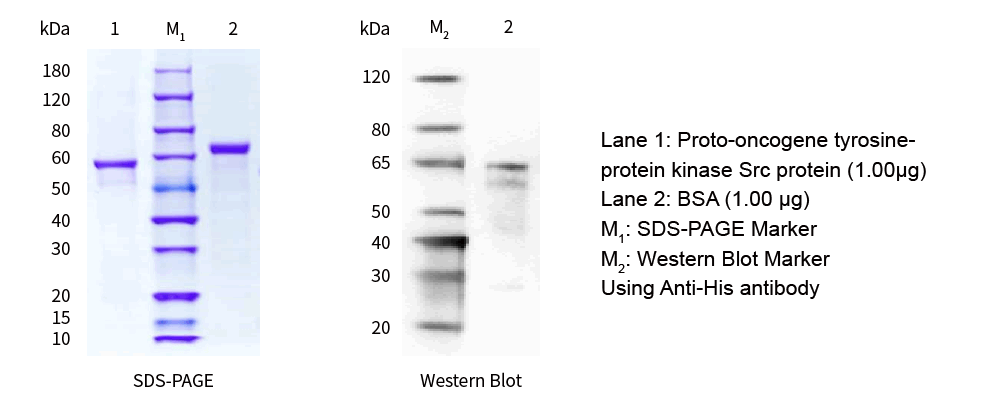
|
Non-receptor protein tyrosine kinase which shows higher basal kinase activity than isoform 1, possibly due to weakened intramolecular interactions which enhance autophosphorylation of Tyr-419 and subsequent activation (By similarity). The SH3 domain shows reduced affinity with the linker sequence between the SH2 and kinase domains which may account for the increased basal activity (By similarity). Displays altered substrate specificity compared to isoform 1, showing weak affinity for synaptophysin and for peptide substrates containing class I or class II SH3 domain-binding motifs (By similarity). Plays a role in neurite elongation (By similarity).
| 名称 | T-cell surface glycoprotein CD3 epsilon chain |
| 纯度 | >90% |
| 内毒素 | <1 EU/μg |
| 宿主细胞 | HEK293 |
| 序列 | MQSGTHWRVLGLCLLSVGVWGQDGNEEMGGITQTPYKVSISGTTVILTCPQYPGSEILWQHNDKNIGGDEDDKNIGSDEDHLSLKEFSELEQSGYYVCYPRGSKPEDANFYLYLRARVCENCMEMDVMSVATIVIVDICITGGLLLLVYYWSKNRKAKAKPVTRGAGAGGRQRGQNKERPPPVPNPDYEPIRKGQRDLYSGLNQRRI |
| 基因名 | CD3E |
| Uniprot ID | P07766 |
| 物种 | Homo sapiens(Human) |
| 产品性状 | Liquid |
| 缓冲液 | 1×PBS,pH7.4 |
| 储存方式 | -80 ℃ packaging and storage to avoid repeated freezing and thawing. |
| SDS-PAGE &WB |

|
Part of the TCR-CD3 complex present on T-lymphocyte cell surface that plays an essential role in adaptive immune response. When antigen presenting cells (APCs) activate T-cell receptor (TCR), TCR-mediated signals are transmitted across the cell membrane by the CD3 chains CD3D, CD3E, CD3G and CD3Z. All CD3 chains contain immunoreceptor tyrosine-based activation motifs (ITAMs) in their cytoplasmic domain. Upon TCR engagement, these motifs become phosphorylated by Src family protein tyrosine kinases LCK and FYN, resulting in the activation of downstream signaling pathways (PubMed:2470098). In addition of this role of signal transduction in T-cell activation, CD3E plays an essential role in correct T-cell development. Initiates the TCR-CD3 complex assembly by forming the two heterodimers CD3D/CD3E and CD3G/CD3E. Participates also in internalization and cell surface down-regulation of TCR-CD3 complexes via endocytosis sequences present in CD3E cytosolic region (PubMed:10384095, PubMed:26507128).
| 名称 | Tumor necrosis factor receptor superfamily member 11A Protein |
| 纯度 | >85% |
| 宿主细胞 | HEK293 |
| 序列 | MAPRARRRRPLFALLLLCALLARLQVALQIAPPCTSEKHYEHLGRCCNKCEPGKYMSSKCTTTSDSVCLPCGPDEYLDSWNEEDKCLLHKVCDTGKALVAVVAGNSTTPRRCACTAGYHWSQDCECCRRNTECAPGLGAQHPLQLNKDTVCKPCLAGYFSDAFSSTDKCRPWTNCTFLGKRVEHHGTEKSDAVCSSSLPARKPPNEPHVYLPGLIILLLFASVALVAAIIFGVCYRKKGKALTANLWHWINEACGRLSGDKESSGDSCVSTHTANFGQQGACEGVLLLTLEEKTFPEDMCYPDQGGVCQGTCVGGGPYAQGEDARMLSLVSKTEIEEDSFRQMPTEDEYMDRPSQPTDQLLFLTEPGSKSTPPFSEPLEVGENDSLSQCFTGTQSTVGSESCNCTEPLCRTDWTPMSSENYLQKEVDSGHCPHWAASPSPNWADVCTGCRNPPGEDCEPLVGSPKRGPLPQCAYGMGLPPEEEASRTEARDQPEDGADGRLPSSARAGAGSGSSPGGQSPASGNVTGNSNSTFISSGQVMNFKGDIIVVYVSQTSQEGAAAAAEPMGRPVQEETLARRDSFAGNGPRFPDPCGGPEGLREPEKASRPVQEQGGAKA |
| 基因名 | TNFRSF11A |
| Uniprot ID | Q9Y6Q6 |
| 物种 | Homo sapiens(Human) |
| 产品性状 | Liquid |
| 缓冲液 | 1×PBS,pH7.4 |
| 储存方式 | -80 ℃ packaging and storage to avoid repeated freezing and thawing. |
| SDS-PAGE &WB |

|
Receptor for TNFSF11/RANKL/TRANCE/OPGL; essential for RANKL-mediated osteoclastogenesis (PubMed:9878548). Its interaction with EEIG1 promotes osteoclastogenesis via facilitating the transcription of NFATC1 and activation of PLCG2 (By similarity). Involved in the regulation of interactions between T-cells and dendritic cells (By similarity).
| 名称 | Cell migration-inducing and hyaluronan-binding Protein |
| 纯度 | >85% |
| 宿主细胞 | HEK293 |
| 序列 | MGAAGRQDFLFKAMLTISWLTLTCFPGATSTVAAGCPDQSPELQPWNPGHDQDHHVHIGQGKTLLLTSSATVYSIHISEGGKLVIKDHDEPIVLRTRHILIDNGGELHAGSALCPFQGNFTIILYGRADEGIQPDPYYGLKYIGVGKGGALELHGQKKLSWTFLNKTLHPGGMAEGGYFFERSWGHRGVIVHVIDPKSGTVIHSDRFDTYRSKKESERLVQYLNAVPDGRILSVAVNDEGSRNLDDMARKAMTKLGSKHFLHLGFRHPWSFLTVKGNPSSSVEDHIEYHGHRGSAAARVFKLFQTEHGEYFNVSLSSEWVQDVEWTEWFDHDKVSQTKGGEKISDLWKAHPGKICNRPIDIQATTMDGVNLSTEVVYKKGQDYRFACYDRGRACRSYRVRFLCGKPVRPKLTVTIDTNVNSTILNLEDNVQSWKPGDTLVIASTDYSMYQAEEFQVLPCRSCAPNQVKVAGKPMYLHIGEEIDGVDMRAEVGLLSRNIIVMGEMEDKCYPYRNHICNFFDFDTFGGHIKFALGFKAAHLEGTELKHMGQQLVGQYPIHFHLAGDVDERGGYDPPTYIRDLSIHHTFSRCVTVHGSNGLLIKDVVGYNSLGHCFFTEDGPEERNTFDHCLGLLVKSGTLLPSDRDSKMCKMITEDSYPGYIPKPRQDCNAVSTFWMANPNNNLINCAAAGSEETGFWFIFHHVPTGPSVGMYSPGYSEHIPLGKFYNNRAHSNYRAGMIIDNGVKTTEASAKDKRPFLSIISARYSPHQDADPLKPREPAIIRHFIAYKNQDHGAWLRGGDVWLDSCRFADNGIGLTLASGGTFPYDDGSKQEIKNSLFVGESGNVGTEMMDNRIWGPGGLDHSGRTLPIGQNFPIRGIQLYDGPINIQNCTFRKFVALEGRHTSALAFRLNNAWQSCPHNNVTGIAFEDVPITSRVFFGEPGPWFNQLDMDGDKTSVFHDVDGSVSEYPGSYLTKNDNWLVRHPDCINVPDWRGAICSGCYAQMYIQAYKTSNLRMKIIKNDFPSHPLYLEGALTRSTHYQQYQPVVTLQKGYTIHWDQTAPAELAIWLINFNKGDWIRVGLCYPRGTTFSILSDVHNRLLKQTSKTGVFVRTLQMDKVEQSYPGRSHYYWDEDSGLLFLKLKAQNEREKFAFCSMKGCERIKIKALIPKNAGVSDCTATAYPKFTERAVVDVPMPKKLFGSQLKTKDHFLEVKMESSKQHFFHLWNDFAYIEVDGKKYPSSEDGIQVVVIDGNQGRVVSHTSFRNSILQGIPWQLFNYVATIPDNSIVLMASKGRYVSRGPWTRVLEKLGADRGLKLKEQMAFVGFKGSFRPIWVTLDTEDHKAKIFQVVPIPVVKKKKL |
| 基因名 | CEMIP |
| Uniprot ID | Q8WUJ3 |
| 物种 | Homo sapiens(Human) |
| 产品性状 | Liquid |
| 缓冲液 | 1×PBS,pH6.5 |
| 储存方式 | -80 ℃ packaging and storage to avoid repeated freezing and thawing. |
| SDS-PAGE &WB |

|
Mediates depolymerization of hyaluronic acid (HA) via the cell membrane-associated clathrin-coated pit endocytic pathway. Binds to hyaluronic acid. Hydrolyzes high molecular weight hyaluronic acid to produce an intermediate-sized product, a process that may occur through rapid vesicle endocytosis and recycling without intracytoplasmic accumulation or digestion in lysosomes. Involved in hyaluronan catabolism in the dermis of the skin and arthritic synovium. Positively regulates epithelial-mesenchymal transition (EMT), and hence tumor cell growth, invasion and cancer dissemination. In collaboration with HSPA5/BIP, promotes cancer cell migration in a calcium and PKC-dependent manner. May be involved in hearing.





南京德泰生物工程有限公司 Nanjing Detai Bioengineering Co.,Ltd. ©2026 All Rights Reserved

 苏公网安备32011202001300